
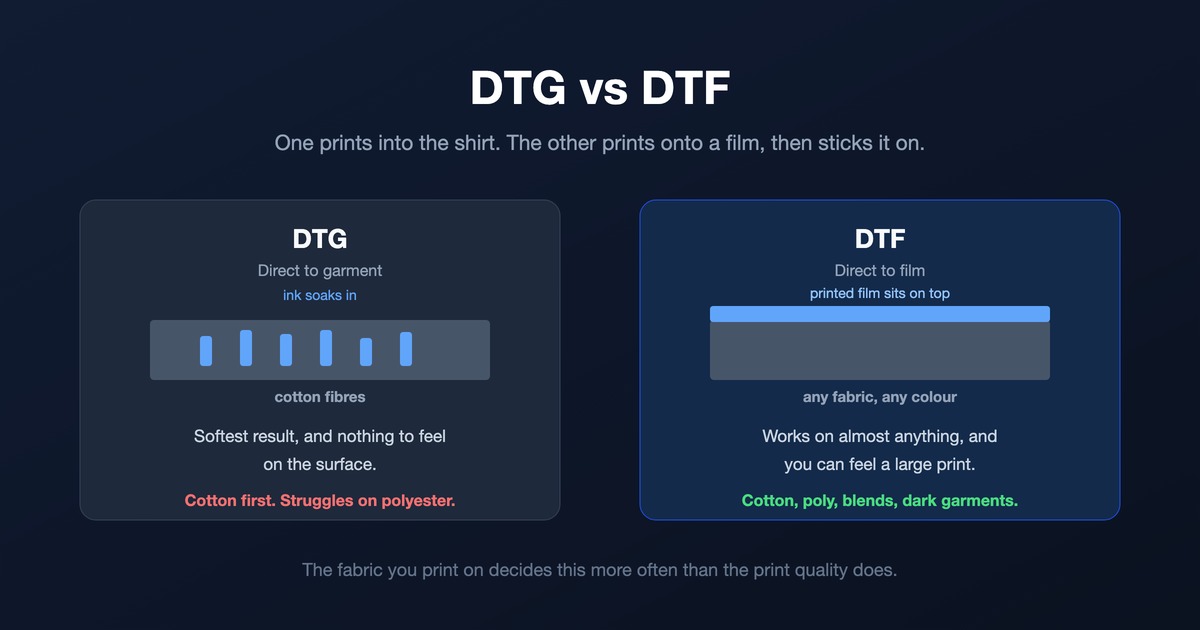
DTG and DTF both put a full-colour print on a shirt, and they are not competing on quality. They are competing on what you are allowed to print on.
DTG sprays ink into the garment itself. DTF prints onto a film that is then pressed on. Everything else below follows from that one difference.
Browse shirt designsFree community designs ready to print and press.See the designsKey Takeaways
- DTF prints on almost any fabric and any colour. DTG is cotton-first.
- DTG feels softer, because there is no film layer on the surface.
- DTF transfers can be made in advance and stored; DTG is printed per garment.
DTG vs DTF Quick Comparison
Every row below is expanded further down. If you only read one thing, read this.
| DTG | DTF | |
|---|---|---|
| Ink goes | Into the fabric | Onto a film, then onto the fabric |
| Fabrics | Cotton first; blends lose vibrancy | Cotton, polyester, blends, nylon, caps, bags |
| Garment colour | Darks need pretreatment and a white underbase | Any colour, no pretreatment |
| Hand feel | Softer — nothing sits on the surface | A thin film layer you can feel |
| Stretch | Moves with the fabric | Can crack if the print is stretched hard |
| Print ahead of orders | No — printed per garment | Yes — transfers store indefinitely |
| Steps per shirt | Fewer, all on the garment | More, but decoupled from the garment |
| Consumables | Ink, pretreatment fluid | Ink, film, adhesive powder |
| Extra hardware | Heat press | Heat press, plus curing oven unless built in |
| Lowest published entry | Dual-function machines only | $2,499 multi-function, $3,199 dedicated |
| Best at | Soft cotton tees in quantity | Mixed fabrics and mixed small orders |
What Is DTG Printing?
DTG stands for direct-to-garment. An inkjet head prints water-based ink straight into the fibres of a finished shirt, the way a document printer prints onto paper.
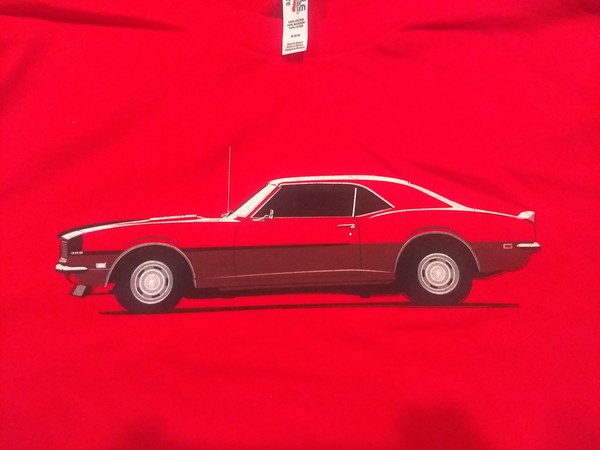
Because the ink sits in the fabric rather than on top of it, there is no layer to feel. Dark garments are pretreated first so a white underbase can hold, and the print is cured with heat afterwards.
That pretreatment step is why DTG is cotton-first: the chemistry is designed for natural fibres. The process in full is in what DTG printing is.
What Is DTF Printing?
DTF stands for direct-to-film. The design is printed onto a sheet of PET film, dusted with adhesive powder, and the powder is melted so it fuses to the ink.
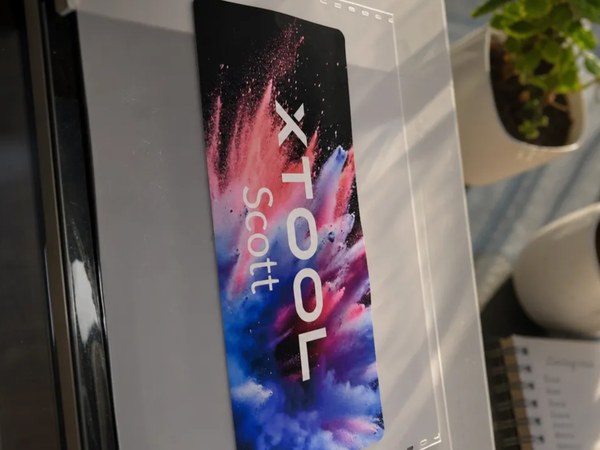
What comes out is a transfer — a finished object you can store in a drawer. Pressing it onto a garment is a separate step that can happen weeks later.
Because the adhesive bonds to the surface rather than the fibre, DTF does not care what the garment is made of. Cotton, polyester, blends, nylon bags and caps all take the same transfer. The hardware side is in what a DTF printer is.
How DTG and DTF Printing Work, Step by Step
Both start from the same digital file. What happens next is entirely different, and every trade-off further down follows from it.
The DTG sequence: pretreat, print, cure
Load the shirt on a platen, pretreat if it is dark, print, then cure with heat. Three or four steps, all performed on the garment itself, one garment at a time.
The DTF sequence: print, powder, melt, press
Print the film, apply powder, melt it in an oven or press, then heat-press the finished transfer onto the garment. More steps — but only the last one needs the shirt.
DTG vs DTF on Fabrics and Garment Colours
This is the aspect that decides most real decisions, and it is not close.

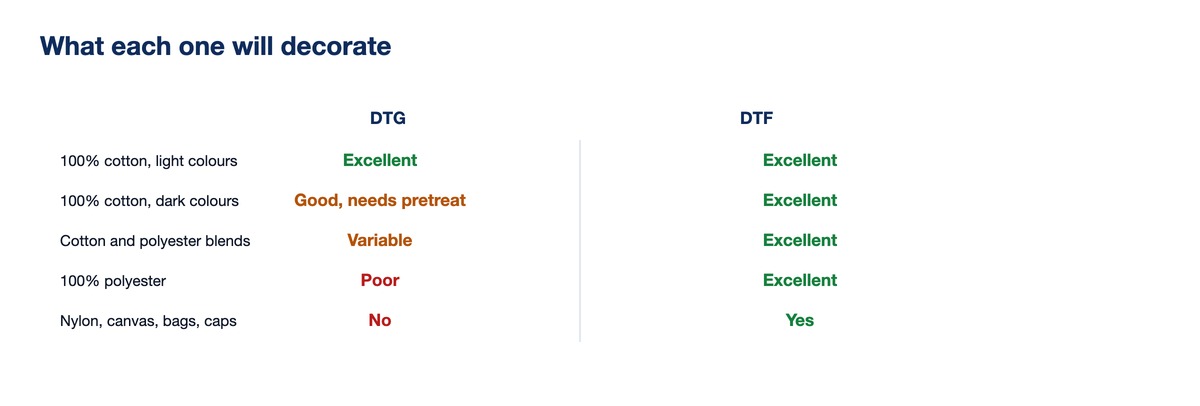
DTG needs cotton
Water-based ink has to be absorbed by the fibre. On 100% polyester there is nothing for it to bond into, and on blends the result varies with the ratio.
DTF does not care
The adhesive bonds to the surface, so cotton, polyester, blends, nylon, canvas and bags all work, in any colour.
If your product range includes performance wear, tote bags or caps, that alone settles it.
How DTG and DTF Prints Look and Feel
Hand feel
DTG wins here, and by a noticeable margin on light cotton. With no white underbase needed, the ink sits in the fabric and the print is effectively undetectable to the touch.
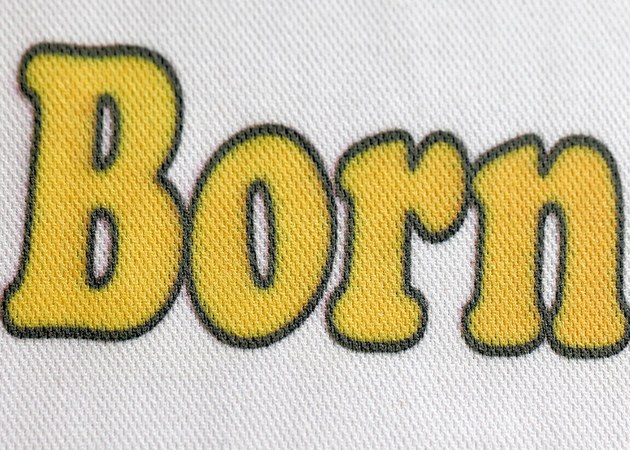
A DTF print is a thin layer of ink and adhesive on top of the fabric. Small designs are barely noticeable; a large solid block is something you can feel.
Colour and detail
DTF holds slightly denser, brighter colour on dark garments, because the white layer is printed on film rather than into a pretreated shirt. DTG on a dark garment depends heavily on how evenly the pretreat was applied.
Stretch
DTG stretches with the garment because it is part of it. DTF has some give but remains a film, so very stretchy fabrics are more demanding to get right.
DTG vs DTF Durability, and How Each One Fails
Both last well when done properly. What differs is how they go wrong, which is more useful to know than a wash-count claim.
DTG fades
Because the ink is in the fibres, wear looks like the garment ageing: a gradual softening of colour, no edges or flaking.
DTF lifts or cracks
Failure starts at an edge or a fold, and it is almost always a pressing fault — too little pressure, wrong temperature, or peeling at the wrong moment.
Most DTF durability complaints are pressing complaints
The transfer is only as good as the press that applied it. Uneven pressure from a cheap press, or a peel done hot when the film wanted cold, produces exactly the edge-lifting people then blame on the process.
DTG vs DTF Workflow and Speed Per Shirt
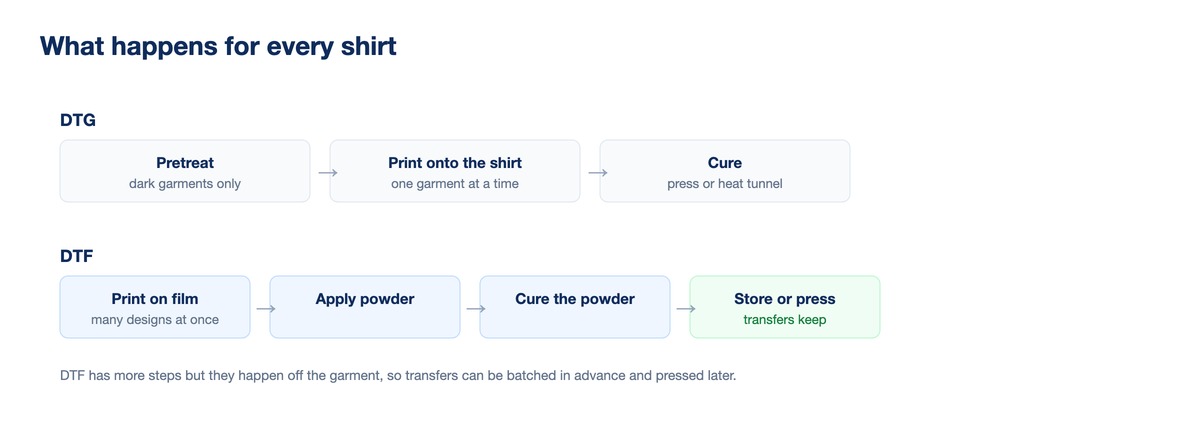
DTG is fewer steps, all on the garment
Pretreat if dark, print, cure. Each shirt occupies the machine for the whole job, and a light-coloured cotton tee skips the pretreat entirely, which makes it very quick.
DTF is more steps, but they decouple
Printing, powdering and curing produce transfers that keep. You can print fifty designs on one film sheet in the morning and press them onto garments over the following weeks.
For anyone selling at markets or fulfilling mixed orders, that separation is the real operational advantage — not speed as such, but not needing the garment present when you print.
Before You Print: What Artwork Each Method Needs
Both methods print from the same kinds of file, but they are unforgiving about different things. This is where most first jobs actually go wrong.
Artwork for DTF
A transparent background is not optional. Whatever is white in your file gets printed with white ink and pressed onto the garment, so a white box behind a logo becomes a white box on the shirt. Our guide to removing a background from a logo covers the fix.
Vector is easiest to scale. A transfer gets printed at whatever size you set, so artwork that scales without softening saves reprints — see what an SVG file is. High-resolution PNG works too, at the size you intend to print.
Watch the fine detail. Very thin lines and small text carry adhesive powder poorly and are the first thing to lift after a wash.
Artwork for DTG
Gradients and soft edges are the advantage here. Ink goes into the fibre, so photographic artwork and blended tones behave better than they do on film.
Still remove the background. On a coloured garment, an unremoved white background prints as a white panel exactly as it does with DTF.
Design for the fabric colour. On darks the printer lays a white underbase first, which shifts how colours read — proof one garment before running twenty.
What DTG and DTF Cost to Start
The two methods do not just cost different amounts. They spend money in different places, and that matters more than the sticker price.
What DTG costs
The machine is the whole decision. Dedicated DTG hardware is business equipment — see what a DTG printer is. Epson's apparel machine is dual-function DTG and DTF and publishes no price on its product page, which tells you the bracket it sits in.
Consumables are ink plus pretreatment fluid. No film, no powder. But dark garments need pretreating and a white underbase, so a black shirt costs meaningfully more to print than a white one — the only method here where garment colour changes your cost per print.
Add curing. A heat press or conveyor dryer is required, not optional. Ours is $159.
What DTF costs
The machine floor is lower. A dedicated DTF printer starts at $3,199 for the HTVRONT D1 standard kit, which includes six 250 ml ink bottles.
Consumables are ink, film and powder. From HTVRONT's own store: a 13 inch × 328 ft transfer film roll is $59.99, 500 g of adhesive powder is $15.99, and a set of six 250 ml inks is $69.99. Three streams to reorder instead of two.
Budget for curing hardware separately. A standalone oven such as the HTVRONT A3 is $399, unless you buy a machine with a shaker oven built in — the xTool Apparel Printer Plus starts at $5,399 and includes one.
Garment colour does not change any of this, which is the flip side of DTG's pretreatment cost.
The cheapest way into either is a machine that does both
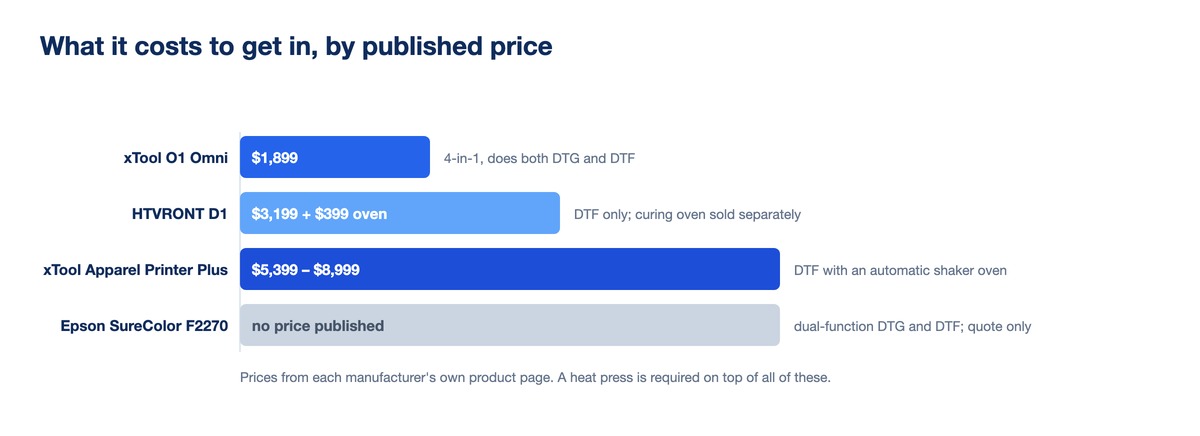
The 4-in-1 xTool O1 Omni starts at $2,499 and its maker lists UV, UV DTF, DTG and DTF. That is the lowest published entry price in this comparison, and it makes the DTG-or-DTF question less binary than it looks.
Whichever you choose, a heat press is not optional — the category is covered in what a heat press is.
A fuller breakdown of what each machine price includes is in the beginner DTF printer guide, with the wider field in the DTF printer round-up.
Running costs are where the two really separate, and film and powder are most of DTF’s. The DTF supplies stocked for xTool printers price those per roll.
DTG vs DTF vs Heat Transfer Vinyl
Most people weighing DTG against DTF have a third option they have not priced. Heat transfer vinyl is the cheapest way to decorate a shirt, and for some designs it also looks the best.

HTV is a sheet of coloured film. A blade machine cuts your shape out of it, you weed away the waste, and you press what is left onto the garment. No printer, no ink — the entry cost is a cutting machine and a heat press.
That is also its limit. The colour comes from the sheet, so photographs, gradients and shading are out. One or two flat colours look sharp; a full-colour illustration does not exist in vinyl without layering nobody wants to weed.
| HTV | DTF | DTG | |
|---|---|---|---|
| Artwork | Flat shapes, text, logos | Anything, full colour | Anything, full colour |
| Colours | One per sheet layer | Unlimited | Unlimited |
| Fabrics | Most, including polyester | Most, including polyester | Cotton first |
| Per shirt | Cut, weed, press | Press a stored transfer | Print on the garment |
| Kit needed | Cutter and press | DTF printer, oven, press | DTG printer, pretreat, press |
| Best for | Names, numbers, one-offs | Mixed fabrics and stock | Premium cotton |
Read it as a ladder, not a ranking. Vinyl for text, names and small runs; DTF once the artwork goes full colour or the fabric stops being cotton; DTG when the garment is cotton and the hand feel is the product. The cutting side is covered in our Cricut heat transfer vinyl review.
Where DTG or DTF Is the Wrong Answer
Do not choose DTG if your garments are polyester or mixed, if you need to decorate bags and caps, or if you want to print transfers ahead of orders.
Do not choose DTF if hand feel is the selling point, if the prints are large solid areas on soft cotton tees, or if you have no reliable heat press.
Do not choose either for a handful of shirts. Cut vinyl costs a fraction to start — see what HTV is — and ordering finished shirts is cheaper still.
DTG or DTF: Which Should You Choose?
Choose DTG if
- You print mainly on cotton, and mostly on light garments
- Hand feel is part of what you are selling
- Your orders are small runs of premium apparel rather than mixed batches
- Every garment is printed to order, so storing stock is not part of the plan
- Large solid areas on soft tees are common in your artwork
Choose DTF if
- You print on polyester, blends, or whatever the customer brings in
- You decorate bags, caps and non-flat items as well as shirts
- Dark garments are routine and you would rather skip pretreatment
- You want to make transfers in advance and press them when orders arrive
- Bright colour on dark fabric is a selling point
Two cases that do not reduce to a rule
You sell at markets or fulfil small mixed orders. DTF, for the storage. Transfers made in advance turn a printing job into a pressing job on the day.
You are not sure yet. A multi-function machine, or outsource the transfers and buy only a press. Both keep the decision open — the routes are compared in how to make custom shirts.
DTG vs DTF by What You Are Printing
If you already know the job, read the row rather than the article.
| What you are printing | Method | Why |
|---|---|---|
| Cotton T-shirts | DTG | Softest result, no film layer |
| Sportswear and polyester | DTF | DTG chemistry is built for natural fibres |
| One-off custom shirt | DTG | No transfer to make first |
| Mixed fabrics in one order | DTF | One transfer type presses onto all of them |
| Bright colour on dark garments | DTF | No pretreatment, no underbase to manage |
| Caps, bags, non-flat items | DTF | DTG needs a flat platen |
| Stock made ahead of orders | DTF | Transfers store indefinitely |
| Premium soft-hand branding | DTG | Ink sits in the fabric, not on it |
Design Ideas for Custom Apparel
Both methods land in the same places: personalised apparel, business merchandise, small-brand runs, sportswear and gift customisation. The method decides the fabric, not the market.
If you need somewhere to start: custom shirts for a group, team and club apparel with names and numbers, personalised gifts, and branded merchandise for a small business. Each one pushes you towards a different method. Browse custom apparel project ideas for designs other makers have already printed.
Five of them are below. Each is a free community file — download it, send it straight to a transfer or a press, or change the name on it first and make it yours.
If this is the start of a business rather than one shirt, starting a clothing brand covers the parts printing does not, and generating a logo from text is the fastest way to get a mark you can actually print.
Printing is also not the only way to decorate a garment. Embroidery suits caps and workwear, screen printing wins on long runs of one design, and sublimation is the polyester specialist that beats both on hand feel.
1. Youth Football Jersey Name and Number
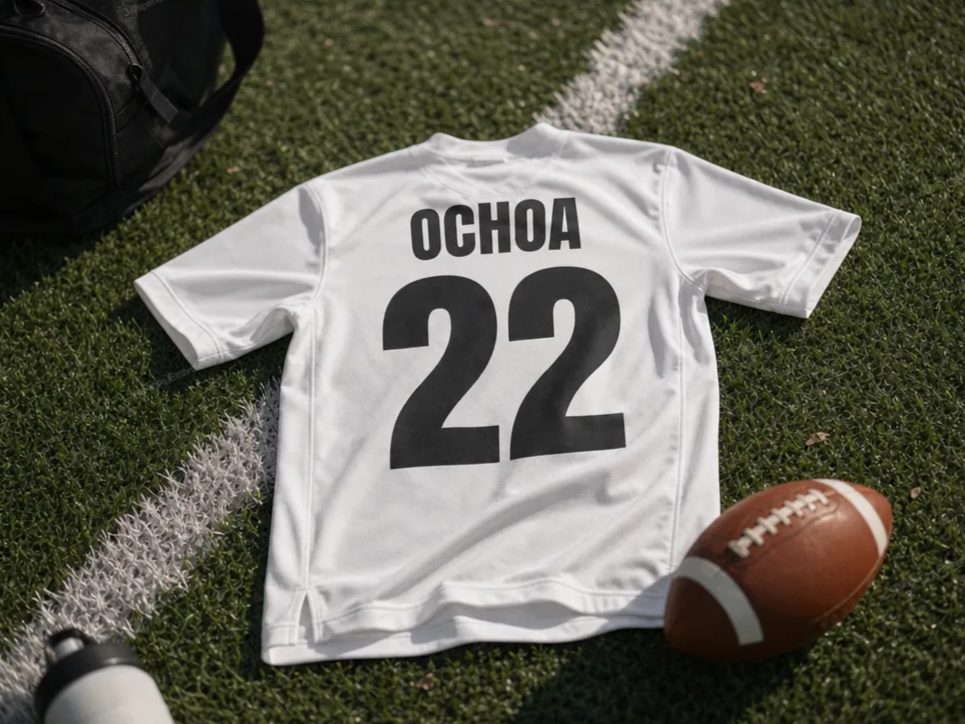
Team apparel is mostly typography, which makes it the easiest custom job to get right and the easiest to get wrong. This one is laid out at youth scale — a 2.25 inch name over an 8 inch number — with the adult sizes noted alongside, so you are not guessing at how big a back print should be.
Get this design →2. First Day of School Graphic

Occasion shirts are the reason most people print one garment rather than fifty. The file is a transparent PNG, so the same artwork presses as a DTF transfer, prints DTG or sublimates onto polyester without redrawing anything. Change the year and it runs again next September.
Get this design →3. Chill13 Club Sweatshirt Graphic
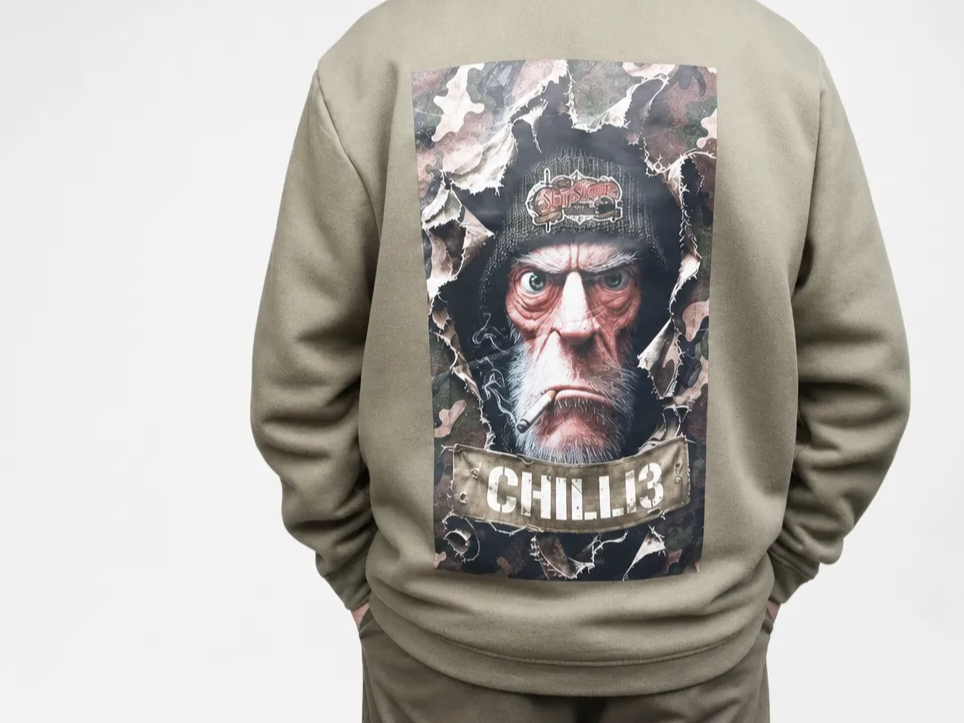
Merchandise for a small group, printed on an olive sweatshirt rather than the usual white tee. The full-back placement and the coloured garment are the interesting part: this is exactly the job where DTF stops being one option among several and becomes the obvious one.
Get this design →4. Halftone Wizard Graphic Tee
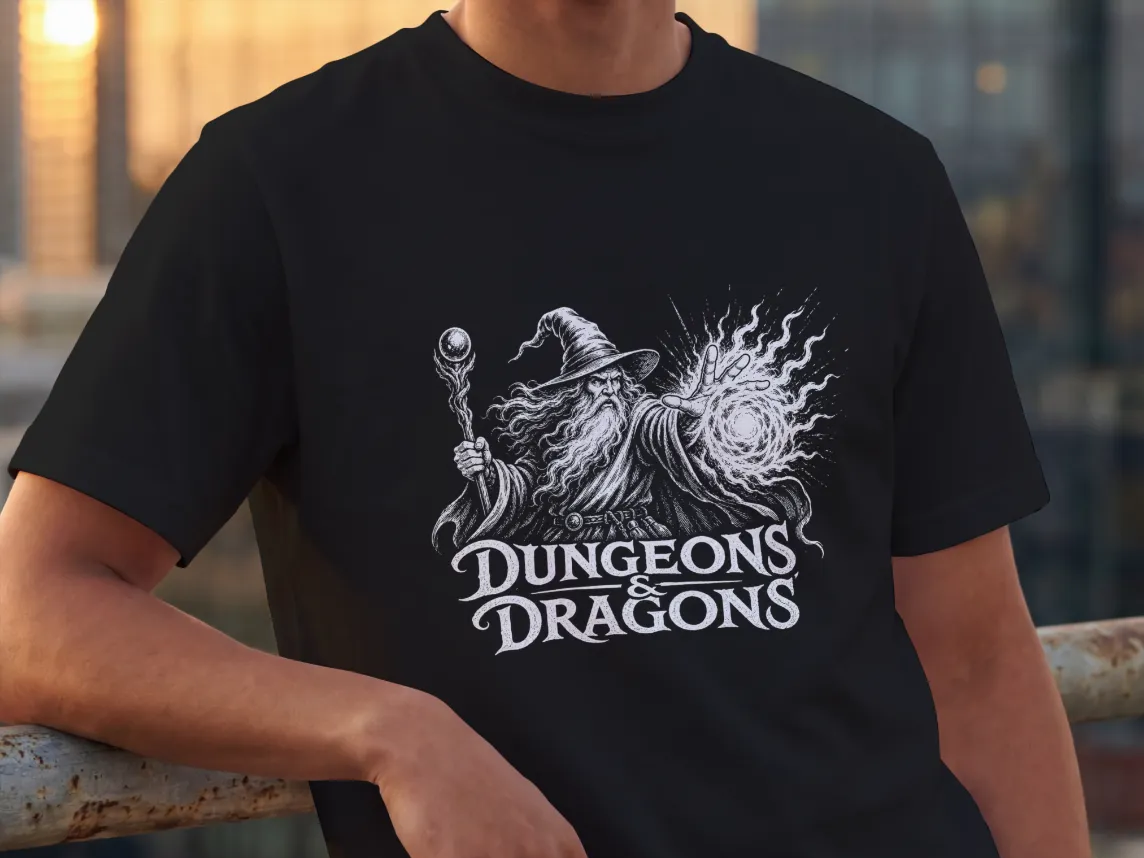
A detailed illustration converted to halftone so it survives being printed on black. Halftone is the trick that lets shading exist on a dark garment without a heavy white underbase behind it, and it is worth studying here before you try it on your own artwork.
Get this design →5. Personalised Name and Doodle Backpack
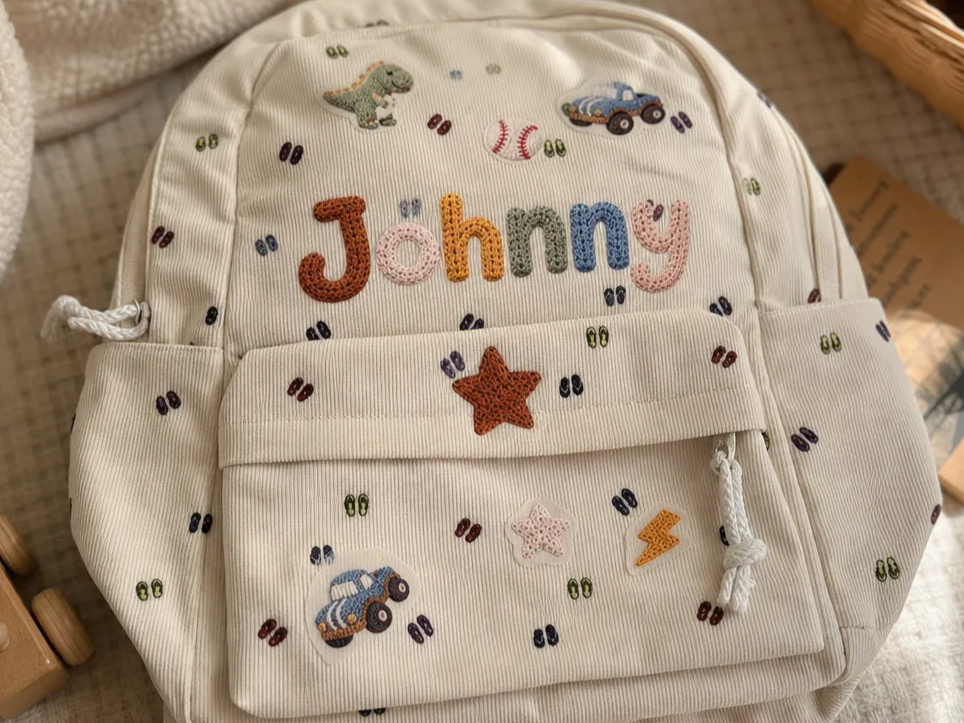
Apparel printing is not limited to apparel. The same transfers that go on a shirt go onto a canvas backpack, which is how one design turns into a matching set. Names, doodles and class logos are all pressed on separately, so nothing has to be laid out as one piece.
Get this design →Conclusion
DTG is the better print on cotton. DTF is the more useful process almost everywhere else, and it is the one that lets you separate printing from pressing.
Answer the fabric question first and the rest follows. If the answer is “cotton tees, and softness sells”, DTG. If it is anything broader, DTF.
And if the honest answer is that you do not know your product range yet, a machine that does both costs less than committing to the wrong one.
Frequently Asked Questions about DTG vs DTF
Is DTF better than DTG?
Neither is better outright. DTF prints on almost any fabric or colour and lets you store transfers; DTG gives a softer result on cotton because the ink goes into the fibre. Pick by what you print on, not by which technology is newer.
Which lasts longer, DTF or DTG?
Both survive normal washing when cured properly, and they fail differently. A DTG print fades gradually with the fabric; a DTF transfer can crack or lift at the edges if it was underpressed or stretched hard. Curing is the variable that decides it.
Can DTF print on polyester?
Yes, and that is its main advantage. The adhesive bonds to the surface rather than the fibre, so polyester, blends, nylon bags and caps all take the same transfer. DTG is built for natural fibres and struggles on polyester.
Does DTG require pretreatment?
On dark garments, yes — pretreatment lets the white underbase hold, and without it colour sinks into the fabric. Light garments can usually skip it. DTF needs no pretreatment at all, which is one of the practical reasons people choose it.
Which printing method is better for a small business?
DTF for most, because transfers can be made in advance and pressed when an order arrives, and one transfer type covers mixed fabrics. Choose DTG instead if you sell premium cotton apparel and hand feel is the thing customers pay for.
Do I need a heat press for both?
Yes. DTF is pressed onto the garment, and DTG has to be heat cured after printing. A press is not an optional accessory for either method, so budget for it alongside the printer.
Which printing method is better for beginners?
DTF, in most cases. There is no pretreatment to get right, garment colour does not change the process, and a failed transfer costs a sheet of film rather than a shirt. DTG is less forgiving because every mistake happens on the garment itself.
Can DTG and DTF both be used for custom shirts?
Yes — custom shirts are the main job for both. The difference is what the shirt is made of and how it should feel. Cotton and a soft finish point to DTG; mixed fabrics, dark colours and printing ahead of orders point to DTF.
What type of designs work best for apparel printing?
Artwork at 300 DPI at its printed size, on a transparent background, with the subject fully separated from whatever was behind it. Vector or high-resolution raster both work. Thin strokes and near-white detail are the two things that disappoint most often.
Start with the design
Browse free community shirt designs, or generate your own artwork to print.
